Sorting Through the “Green” Stuff at MaLode

There is a lot to learn about making your home, business or lifestyle “Green”. Here at the River Center we have discovered that if you want to learn how to save money and reduce fossil fuel consumption most cost effectively, it pays to stop listening and start thinking. Yes, more information is good, but so much of it consists of confusing “infomercials” for a new kind of “Green Consumerism”.

Take energy for instance. In 2007 when we drew up our Greenhouse Gas Action Plan (GAP) we were aware that most folks associated solar energy with photovoltaic (PV) panels. In fact, our neighbor had recently installed a fancy new set of PV panels that made us, quite frankly, envious. We heard there were tax credits and good deals to be had, and dreams of PV panels began dancing in our heads.

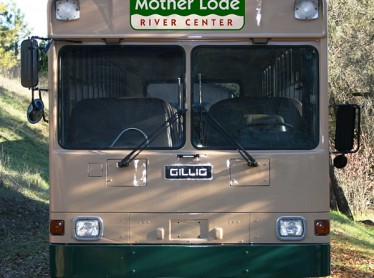
Then we did the math. Once we ranked the sources of our greenhouse gas emissions in the GAP, we discovered that not only was our use of electricity comparatively low, it largely came from pre-existing hydroelectric sources which produced very little new greenhouse gas to operate. In fact, most of our greenhouse gases were coming out of the tailpipes of our vehicles, not from our electric pole. This led to the EcoBus and our fleet of vehicles powered by waste vegetable oil (WVO), a fuel that produces 80% less carbon emissions than conventional fossil fuel.

Furthermore, we discovered that after vehicle fuel, our next largest producer of greenhouse gases was the heating of hot water with the fossil fuel, propane. Alan Carrozza, our solar expert, then suggested that after insulation, solar hot water heating was our next logical energy investment and that it would be much more cost efficient than PV electricity.

This motivated our first solar water heater, a simple “passive” system that cost approximately $1500 and which produced 28,750 BTUs of energy daily. To compare this system to PV we convert BTUs, a measure of thermal energy, into to kilowatt-hours by multiplying by the factor .0002931, resulting in 8.43 kilowatts. An 8.4 KW photovoltaic system would cost approximately $1000 per kilowatt or $84,000. Bottom line, the solar hot water heater produces the same energy 56 times more cost efficiently than the PV panels!

Just for a point of reference, we asked our neighbor if they had installed a solar hot water heater since, like the average American homeowner, over 33% of their energy is used to heat water. Predictably, the answer was no.

How could this be? These folks are not dumb; on the contrary, they are very smart, idealistic, and trying to do the right thing. What we realized, however, was that they were just like us, at risk of becoming victims of “Green Consumerism”. Like other forms of consumerism, the green variety claims that if it costs a lot, is fashionable, and or looks green, it must be green. Clearly, this isn’t true. BP and its “beyond petroleum” advertising campaign are a great example of “green consumerism” and it is no coincidence that they are the largest seller of PV panels in the US, yet they don’t sell solar hot water heaters at all. Why? Less profit!

We learned several things from this experience. One is that the mantra, “Reduce, Reuse, Recycle” is actually very logically sequenced. Unless we Reduce what we consume first, the Reuse and Recycle have a hard time reducing the net impact on the planet. As the video “The Story of Stuff” points out, the stuff we already produce would require 5 planet Earths to be sustainable. Furthermore, when we produce stuff, it is always “Toxins in, Toxins out” and those toxins always end up somewhere. Since toxins concentrate in biological systems, it turns out that human breast milk has the highest concentration of toxins of any food we consume. Wait a minute, can that be right? Check it out at www.storyofstuff.com. Once you do, you will probably agree that we should all take the advice of Daniel Goleman who proposes in his book, Ecological Intelligence, that we do the math and determine the total ecological cost of everything we buy, and let these numbers guide our purchases.

So what does this all mean at MaLode? No doubt it won’t surprise you that we now heat all our hot water at MaLode with solar energy. This requires three separate solar heaters of two basic types: active and passive. Each system “pre-heats” the water from the well with solar energy before it goes into a propane water heater. This ensures that the hot water is at the desired temperature and neither too cold (it is warmed up with propane to the target temperature), or too hot (it is cooled down by being mixed with more cold water). The passive system is best suited for a lower volume use such as the kitchens. Both types of system reduce propane use by approximately 70%.

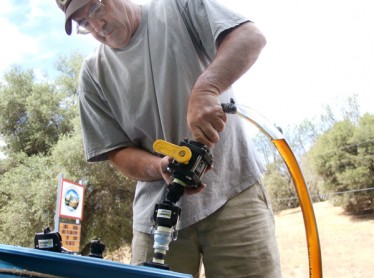
We are particularly proud of the “active” system that powers the showers and which was designed by Alan Carrozza (pictured on the left) and completed last winter by our tenant, Cornelius (on the right). In this case an electronic brain senses the temperature in the solar hot water heating panels. If the temperature is higher than the water stored in the solar hot water reservoir tank, an electric pump is activated to circulate the water from the panels to the solar reservoir. This system can produce more hot water than the passive system, which is why we chose it for the showers where we encounter our highest volume of hot water use.

So ends another happy chapter at MaLode. We are excited about moving forward, albeit deliberately, toward energy independence and ecological sustainability. This season one of our guests suggested that we use a super efficient steam engine he has invented, which derives its energy from solar thermal panels, to turn an electric generator that would produce our electricity. Hmmm, Stay tuned. In the meantime, we look forward to your next visit and, by the way, use all the hot water you want. That is, if you can wring it out of the low flow showerheads donated to us by PG&E!

See you on the River,
Scott and the MaLode Crew

“Solar for Oil” Barter: It’s very Cool

by Scott Underwood

Short on cash? Wouldn’t you like to find a way to reduce your utility bills, decrease America’s dependence on foreign oil, and do a favor to the environment by decreasing your use of fossil fuels? If you answered “yes” to any of these questions, you should be interested in what the Mother Lode River Center has been up to recently in nearby Cool, California.

The basic idea is simple. First, we construct a homemade “box” hot water heater from a sheet of plywood, an old retired propane water heater, a cast off shower door and some fittings from the hardware store. We plumb it all together with simple hand tools using plans available for free on the Internet. We then install it as a “pre-heater” to feed into the existing water heater at one of our favorite restaurants in nearby Cool, Ca.  This reduces the restaurant’s use of propane to heat water by 70%. Since over 33% of the energy consumed by an average household is to heat water, this cost savings and major reduction in carbon footprint is available to you too. I hope you agree that we have closed a Cool deal.  But hey, it gets better!

This restaurant uses vegetable oil to fry its food and normally pays to get it hauled off. We then barter the hot water heater for the restaurant’s waste vegetable oil (WVO).  Barter is “the exchange of goods or services without money” and is definitely a good thing because it keeps trade close to home.  Mother Lode is one of the few companies in California that runs its diesel vehicles on 100% WVO. This has several advantages. First, it produces 80% less carbon dioxide than conventional fossil fuel diesel and therefore vastly reduces our carbon footprint. Second, using WVO also reduces the particulates (the greatest disadvantage of diesel engines) by 45% and hydrocarbons by a comparable amount. Amazingly, it also reduces carcinogens by 90%. Bottom line, it is one of the cleanest and ecologically responsible fuels on planet Earth.

That’s it, “Solar for Oil”! We have created Green Collar employment for our staff, reduced greenhouse gas emissions and spared the planet’s ecosystems, helped reduce the concentration of chemicals in the air that cause asthma and cancer, and refused to ride with Osama Bin Laden. Do you support this idea? Write us a note and let us know what you think.

Mother Lode's 100% WVO Fleet

Many thanks to Alan Carrozza for his inspiration and great idea, Greg Hawkins for his construction skills, Ray and Lorrie for their patience and Emily for her photos.

American River Rafters Support Solar Power

Archer School Students Write Letters to their Legislators

What better way to conclude your freshman year in high school than by rafting, hiking and camping on the historic and beautiful South Fork of the American River in Coloma, California? For five days this week, the Mother Lode River Center and Santa Barbara Adventure Company played host to seventy members of the freshman class of the Archer School for Girls. These intrepid adventurers tent camped on our beach, rafted two days, hiked another day and generally had the time of their lives! Spending an extended period outdoors helped them encounter the natural world while learning about themselves, bonding with their classmates, and expanding their ability to accomplish team challenges such as navigating a raft through Class III whitewater rapids.

Seamlessly integrated into these activities were challenge course group games that heightened their awareness of their surroundings and also promoted connection to each other and the natural world. Campfires, facilitated sing-alongs, quiet time by the ever changing river- all these elements combined to make the experience something the students will remember fondly and benefit from for the rest of their lives.

This season the students also had the advantage of encountering the new Sustainable Practices Program at the River Center. For instance, each time they left the river center in Mother Lode’s new EcoBus, the fuel powering their journey was ecologically responsible 100% waste vegetable oil which reduced their carbon footprint by 80% when compared to the use of petrochemicals. The hot water they used in the kitchen was heated by our new solar panels. The Solar Energy Exploratorium was open for those interested and during their visit “PLUGRIN” the electric car made its debut demonstrating the potential for a true zero emissions vehicle.

On the their next to last day, blushing with the success of running “Troublemaker”, the largest rapid on the exciting Chili Bar Run, they had the opportunity to exercise their environmental muscle as well. One of their guides explained the importance of supporting the investment tax credit for solar power by writing a letter to their legislator. They enthusiastically wrote eloquent and well informed letters that Mother Lode will forward to Governor Schwarzenneger, President Bush, Senators Reid, Boxer and Feinstein and Speaker of the House Nancy Pelosi as well as the three candidates for President. By requesting a reply, these letters will allow each of them to discover where their political leaders stand and make each of them aware of their power to change the world in positive ways.

Experience, Connection, Observation, Stewardship- this is “ECOS” and for over thirty years this has been the Mother Lode Way. These Archer School students had a great opportunity to encounter and complete the full circle. We are pleased to have been a part of their world and we look forward to collaborating with the Santa Barbara Adventure Company to bring similar experiences to other students from the Los Angeles area in the future.

Solar Exploratorium Opens on the American River

As you can see, the Exploratorium benefited from the artistic talents of Allen Carrozza whose Earth portrait exceeded our expectations by several parsecs! The Moon portrait is even more remarkable and the “Earthrise” behind the Moon is truly outstanding. You must see it. It is rare to find someone who is an expert in solar installation, an artist, a sculptor and who knows what else? Stay tuned for more surprises.

The “timeline” is the final touch as yet to be completed but, as the picture illustrates, certainly is not needed to make this space both entertaining and educational. It will decorate the ceiling and stretch from 4.5 billion years ago and the beginning of our solar system to the present, a span of roughly 60 lineal feet. Our Sun, a medium sized star, is the hero of this saga as the source of energy that has made it all possible. Interestingly, had the Sun been a giant star, it would have burned out ages ago, a victim of its own gravity. Although there is controversy over the exact time of the beginning of the saga, the longest period it can continue is more clear. The Sun will inevitably heat up, become a “Red Dwarf” and ultimately burn out approximately 650 million years from now, a relatively short time on this timeline but a long time by human standards.

If I remember my college biology correctly, the origin of life on Earth is placed on this timeline at approximately one third of its length, making each living species a genetic message and evolutionary legacy 3 billion years old. It is humbling to recall that humans appear in the last millimeter of this timeline. In fact, if the timeline were Mt. Everest, all of human history would be the last few snowflakes.

It is the legacy of “species diversity” that is currently disappearing at a rate that exceeds any known to have occurred in the past. This is in what is now being termed the “Sixth Great Extinction.” For comparison, it is useful to recall that the Fifth Great Extinction was the disappearance of the dinosaurs and approximately one third of all species then living on Earth that occurred over 65 million years ago. This extinction took over a million years. By contrast, the Sixth Extinction, if current trends continue, will account for the disappearance of 50% of the all species on Earth by the year 2050. This extinction would be the first massive extinction caused by a single species….us! The primary mechanism is not global warming. Rather, it is habitat destruction, the majority of which is concentrated in the tropics where the greatest number of species on the planet lives.

We hope the “timeline” and the other exhibits will provide food for thought. As has been the case before, the Sun holds the key to many of the potential answers to these challenges. We look forward to your visit and are excited to share these solutions with you.

SEE you soon,
Scott, Allen, Danielle and the MaLode Crew

Eco-Rafting on the South Fork of the American River


For the 2008 season we are pleased to announce dramatic progress toward meeting the goals of our Greenhouse Action Plan. Our “Eco-Bus” is the first 100% waste vegetable oil (WVO) powered bus on the South Fork of the American River, will reduce carbon emissions profoundly each and every time it carries passengers down the highway. On the Chili Bar Run we will achieve up to an 80% reduction from our baseline carbon emissions.

Over a year ago we announced a first for the rafting industry, Mother Lode’s Greenhouse Gas Action Plan (GAP). In that plan we committed to reduce our overall carbon emissions 20% by 2012, 40% by 2040 and 80% by 2050 with 2006 serving as our baseline. It was then, and remains now, a tall order, our new Eco-Bus is a giant step towards reaching our goal.

How We Reduce Your Carbon Footprint
Vegetable oil represents one example of renewable solar energy converted by plants through photosynthesis into liquid form. Although there is little or no carbon savings using virgin vegetable oil due to the petrochemicals used to till, harvest, manufacture and transport it to the point of use, “waste” vegetable oil (WVO) is a different matter. By reclaiming WVO from restaurant garbage we are recycling and reusing a resource. Additionally, its usual manner of disposal produces more carbon emissions than our using it as fuel. An added bonus is the fact that vegetable oil produces fewer air pollutants than either petroleum diesel or gasoline. Remarkably, using WVO reduces air pollution and greenhouse gas emissions simultaneously!

Step 1: Collecting Vegetable Oil
To maximize the environmental benefit we get our waste vegetable oil locally to reduce the cost in carbon and our time.

Step 2: Returning to the Farm: Making Bio-Diesel
Dr. Diesel’s purpose in inventing the diesel engine in 1897 was to allow farmers to use 100% vegetable oil to run their farm machinery. Although we initially successfully made blended bio-diesel, we realized that to use vegetable oil to full advantage one needs to commit to using it 100% pure. Anything less dilutes its beneficial effects. Dr. Diesel, the “full veggie” please!

Step 3: Refining 100% WVO: Accept No Substitutes.
Our 100% WVO system includes two electrical heaters to thin the oil, three electrical pumps to move it, two steel barrels to contain it, an aluminum canister housing a bag style filter, and a centrifuge to extract the last bit of water. The system is permanently installed it in a retired bus, which also serves as our storage facility. We control the system through a breaker panel and 3 timers all connected to a RV style electrical hookup. This set-up is fully mobile and ready to visit the next World’s Fair.

Step 4: The Right Bus.
An unmodified diesel bus will not run on 100% WVO. A conversion must be performed, the expense of which can easily exceed the cost of the bus. The right bus is therefore mandatory. We shopped for over eight months to find ours, a supercharged and turbocharged 1987 Gillig Phantom with only 106,000 miles, a perfect body, and a silky smooth “air ride” suspension. Jim Stepp, our head driver, and I went to Los Angeles and outbid several disappointed fellows whose vision was to turn our bus into a mobile condo in Mexico. We christened her “Eco-Bus” and drove 400 miles north to Coloma. Thanks Ron and Jim! This fall the bus got a paint makeover in MaLode earth-tone tan and forest green and she looks great.

Step #5 A 100% WVO Conversion – Not for Amateurs.
Unlike a Mercedes or Volkswagen, “big rigs” are not easy to convert yourself. Each system is customized to the vehicle that uses it. As it turned out the two major U.S. vendors are both located east of the Rocky Mountains.

Fortunately we found a kind of “alternative energy mad scientist” quietly inventing sophisticated counter-current exchange, continuously heated, precision welded aluminum, 100% WVO systems that are efficient, reliable and operate well at all temperatures. Based upon what I knew about other systems, I was amazed to learn our bus would transition to WVO within two minutes or less of engine start-up, thus keeping our use of “Dino-diesel” to an absolute minimum.

Step #6 Fast Forward to the Year 2050
With the Eco-Bus up and running, it was time to find the way to use it most efficiently to reduce carbon emissions for the introduction of “Eco-Rafting”. The Chili Bar Run was the most energy efficient choice by far with an estimated carbon savings of 80% from our 2006 baseline! This means we can meet the 2050 goals of our GAP on the Chili Bar Run in 2008, approximately 42 years ahead of schedule!

Rest assured, the Eco-Bus project is only one aspect of Mother Lode’s overall effort to complete our GAP. Nevertheless, it is a very encouraging start and if you take a shower at our camp this season the hot water will come from a solar “box” heater, photovoltaic power is on its way, and many other changes are anticipated as elements of our evolving Sustainable Practices Institute- but that’s another story. To learn more about our Eco-Bus.

We cordially invite you to “Eco-Raft” this season and take this opportunity to reconnect with Nature, have fun, and enjoy an exciting whitewater adventure with your friends and family, all for $99! Click to find out more about these specially priced Eco-Rafting Trips on the South Fork American River.

We look forward to seeing you on the river.
Scott Underwood and the MaLode Extreme Green Team
Aaron, Allen, Ron, Jim, Richard, Greg, Rich, the Mystery Painters, and Charlie the River Dog

MaLode Shoots the Gap

It is difficult to watch the news without hearing about human induced climate change and global warming. Although I’ve been aware of this problem since college, I’m not any different than most folks, I could be doing a lot more about dealing with it! (See the entire GAP in Scott’s blog.)

The Mother Lode Greenhouse Gas Action Plan (GAP) is our effort to get up to speed on this issue and we urge you to join us. The plan makes it clear that we don’t intend to neglect the other environmental priorities that confront humankind, nevertheless, we intend to meaningfully address the crisis of global warming. Our goal is to reduce our own carbon emissions by 20% by 2012; by 40% by 2020; and by 80% by 2050. Here are some high points: First, Conservation will be our centerpiece and we will reduce our carbon imprint by using less and operating more efficiently; Second, Technology: We will use energy efficient appliances, light bulbs, etc.; We will install enough solar panels to drive our meter backward and be a net producer of clean electricity; We will reuse cooking oil in bio-diesel driven vehicles and “move down the stalk” to cellulose-based ethanol as it becomes available; We will use a hybrid vehicle whenever possible and go to a plug-in hybrid as soon as they are available; Third, Education and Advocacy — We will be doing a variety of things you can check out on our website. We look forward to your suggestions as well and hearing about how you are addressing the GAP at home and at work.

Jump in the Pool!

There is one especially good way you can help us close the GAP: Carpool your group!

It helps to do the math: 4 people in a vehicle that gets 15 miles per gallon equals 60 person-miles per gallon. This is the same carbon efficiency as one person driving a Prius getting 60 miles per gallon! This season we will have VIP parking for car-poolers and be using the proceeds from the sale our new eco-t-shirts to add to our global warming effort. For example, one T-shirt reads: “Carpoolers never fall out of the boat! Hybrid carpoolers walk on water!” Check it out at the Camp Store and wear a shirt proudly.