by Scott Underwood, M.D.
Read the rest of this page »
Mother Lode River Center Blog
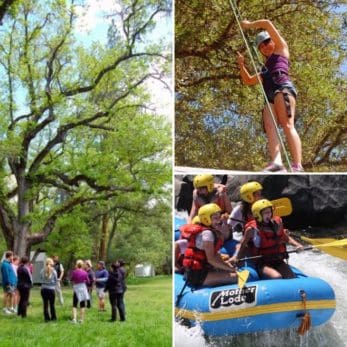
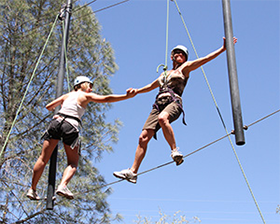
The newest addition to the Malode toy box is a 370’ zip line. This Ropes course element will be used to enhance our outstanding High Ropes programs as well as an addition to any of our rafting trips. For example, you are scheduled for a white water raft trip; you could add a ride on the Malode zip line for a nominal fee making your adventure on the South Fork American River even more memorable!
The Mother Lode staff will get you into your harness and helmet, go over the safety precautions then get you attached to the zip-line. The Mother Lode zip-line starts at the top of our property under majestic Blue and Valley Oaks. From this point you will launch into space and soar over the campground and through the trees reaching speeds close to 30mph! At the end another staff member will assist you onto the platform then lower you gently to the ground.
Zip line Pricing:
1 Zip: $30
2 Zips: $50
3 Zips: $60
Call for availability
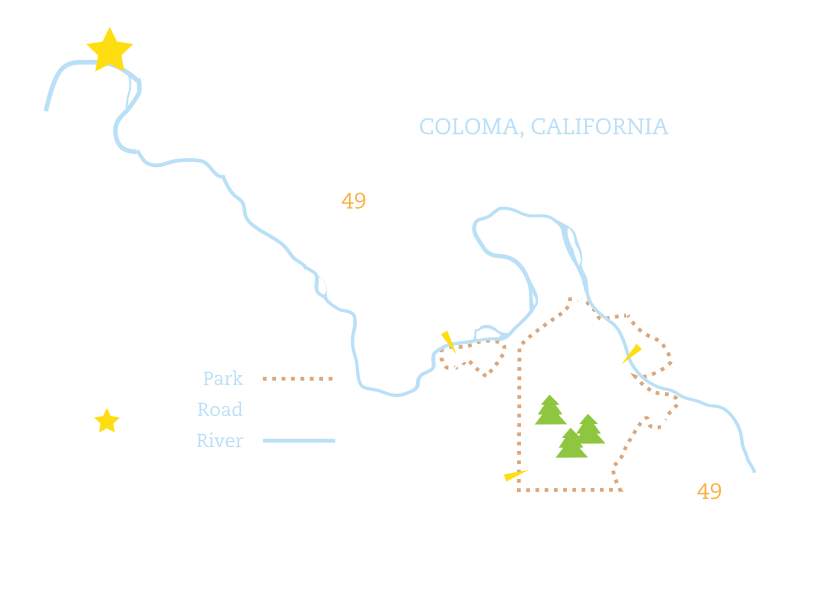
The opening of the American River Trail in Coloma provides exciting new hiking access to over twenty miles of riverside trails along the banks of the South Fork of the American River in Coloma, California. Access to this trail for hiking, mountain biking and equestrian use began officially with the opening of the trail on October 1st, 2010.
This spring, for the first time, Mother Lode River Trips will begin providing a new way to both enjoy the Trail and the exciting whitewater rapids of the American River itself. Called “River Trails” the adventure begins at the Mother Lode River Center which is located a short distance from the American River Trial’s easternmost trailhead. You will depart the River Center on a guided hike downstream of approximately 5 miles that will cover some of the Trail’s most beautiful terrain. You will stroll over rolling hills, through forested canopies of oaks, pines and cedars, and never be far from the banks of the river with its refreshing upstream breeze. At the hike’s end you will be treated to a hearty lunch and refreshing drinks delivered by gear boat to the lunch spot.
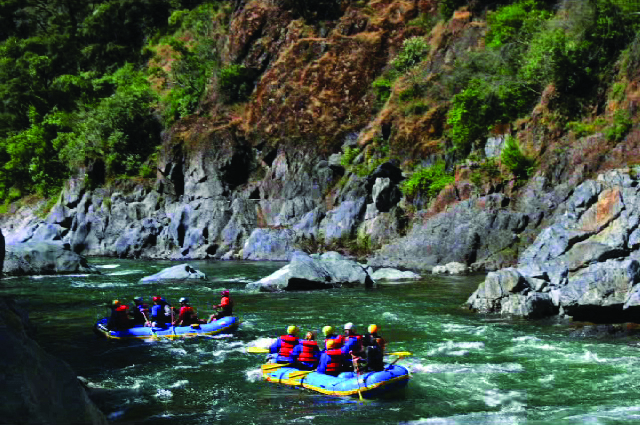
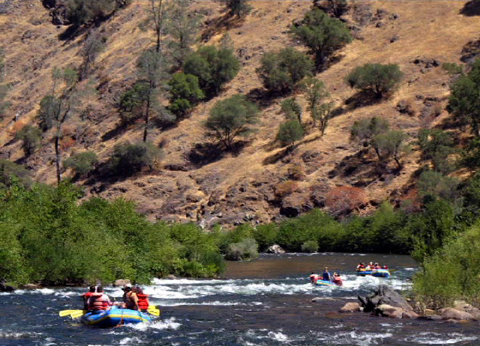
The excitement now begins to build, as the hikers witness the arrival of a line of state-of-the-art, self-bailing rafts each of which is being solo guided, canoe style, by an expert whitewater professional. Personal Floatation Devices are fitted, a safety briefing is performed, and the whitewater excitement begins as the hikers are transformed into whitewater rafters. Ahead lies the South Fork’s most popular white water run, the “Gorge”, which is filled with exciting Class II and III level rapids suitable for beginners and yet thrilling for all.
For those interested in a longer, overnight adventure, camping is available either in the luxurious riverside Mother Lode River Center with its tent cabins, flush toilets and hot showers, or, alternatively, wilderness camping is an option. In both cases delicious home cooked meals are provided that rival grandma’s home cooking and the friendly and knowledgeable Mother Lode guides share natural history interpretation of the flora, fauna, geology and human history of the region. Speaking of history, these trips all include gold panning instruction in the very area that attracted the 49ers and helped make California a State. With any luck you will cry Eureka too!
Remember it as “River Trails.” This river trip is found exclusively at the Mother Lode River Center, your Geotourism portal to the American River.
Spending time together on the river is one of the best ways to enjoy family life. I remember rafting the Grand Canyon on my honeymoon, a father/daughter bonding trip with my two teenage daughters on the Tuolumne, and the whole dang family clan enjoying the South Fork of the American River. I simply can’t remember any family times I have enjoyed more.
It isn’t that I don’t enjoy my family in other vacation venues, like Hawaii, I very much do. It’s more that all the issues that keep us apart elsewhere just melt away on a river trip. What’s for dinner and who does the dishes? Gone. What to wear? Look in that tiny little bag, silly goose. What day is it? Who cares!
I especially love the sound of the river at night, the scent of campfire smoke and the taste of s’mores, followed by sleeping under a canopy of stars. I relish waking up to the smell of breakfast cooking on the stove. Then it gets really fantastic, running whitewater rapids and watching my girls whoop and holler like they don’t have a care in the world.
Trips like these are ones to be remembered for a lifetime. They are excellent opportunities for families to just be focused on each other while experiencing fun and adventure, escaping everything else for awhile. You leave longing for the next time….
Our sedentary culture seems to nurse a love of thick-walled boxes that makes us leery of impermanent housing. Who hasn’t sneered at the man who lives in a van down by the river? But river guides will attest to the freedom and joy of transitioning from a stuffy winter box every spring into an airy, riverside bedroom. Ditching moldy roofs for translucent tarps stretched over wooden frames, and linoleum and carpet for leaf-strewn platforms, we set up house by stringing a few thrift store sheets up for privacy and hanging up a pair of board shorts. The more domestic of us arrange a few potted plants in front of the sheet-door and call it good.
This simplicity, self-sufficiency, and connection to the natural world embodies the spirit of the yurt, a lovely example of which has now arrived at Mother Lode. With no corners for the wind to catch, the earliest yurts were built to endure the wind-raw steppes of Central Asia, and yet their basic elements – circular lattice walls, cone shaped roof, and rafters that meet in a central ring – could be assembled in thirty minutes and taken down just as quickly. Two or three camels can comfortably carry a medium sized yurt and all of its household goods, just as one beat-up Subaru Legacy can carry a river guide’s wordly possessions with a kayak strapped to the top. (All this info on yurts, and more besides, can be found in the book Yurts: Living in the Round, by Becky Kemery)
Guides don’t get to live in yurts for the summer at Mother Lode –yet. But guests and guides alike can enjoy the spacious, 20-foot diameter yurt as a space to imagine a lighter, less cumbersome existence, and ponder the following quote: “If in our lifetime we suppress nomads, we shall have done by human harshness what natural harshness could not do. To abolish nomads because they have other skills, know other things, hold other aspirations, and live by other customs than ours – in short, because they are different – is as unwise as it is unworthy… There is a place for nomads in the world, often enough a place we cannot use without them. We must not steal it from them, for if we do, we reduce the richness of human life – we rob ourselves.”
Neville Dyson-Hudson
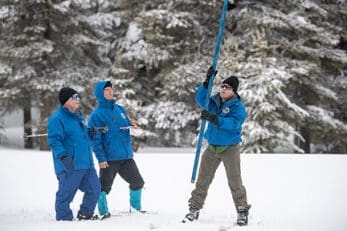
Whitewater rafting is a primarily spring and summer sport, so how does Mother Lode’s hyperactive crew get their wiggles out when it’s freezing? Skiing, snowboarding and snowshoeing, of course! As all California outdoors people know, this has been a banner year for snow in the Sierras, with the deepest December snow pack in 17 years. We hope that, like our whitewater guides, you have been spending glorious weekends riding the slopes and snowshoeing in our beautiful backcountry. The fluffy white stuff is even more exciting when you consider what happens next – it melts, flows downstream and we get to ride it as whitewater rapids. Great thing, the water cycle. We are thrilled that this bountiful winter has ensured great flows on the Middle and South Forks of the American River. We can’t be sure yet about how high, early or long the wonderfully wild North Fork American will flow, since it isn’t dam-controlled, but watch for more blog posts as we monitor the Snow Survey. It looks like a great year for rafting on all three Forks.
Surfing the Internet I discovered something new the other evening: “virtual environmental education and teambuilding”. Apparently you can catch some pretty wild rides and achieve some serious bonding without leaving your couch!
Unfortunately, my old buddy John McKinstry never got to see it, the Internet that is. He had to settle for the real thing. Forty years ago we used to sit together on our boards at sunrise, waiting for the surf to come up. John was among the first to surf the big waves at Ghost Trees in my hometown of Pacific Grove. He had the courage to charge down the face of those massive forty footers, long before jet ski pull ins, or rather, pull outs. John pushed the limits of the possible and was an astronaut on a surfboard. Like many American pioneers he paid the ultimate price doing what he loved most.
I miss John, and a lot of other things that we enjoyed together, many of which are now paved over, but I particularly miss his questions. Once, as we passed a used car lot with a banner advertising “transportation cars”, John asked me: “What other kind of cars are there?” In this age of human induced climate change, that remains a great question.
So if we could ask John whether the experience of wild nature, or bonding with your fellow human beings, can really be replaced with virtual reality, what would he say? For that matter, let’s ask ourselves that question. But before we answer, perhaps we should ask our kids to tear their attention away from their video games, TV shows, computers and cell phones and ask them too.
Neuroscientists can now offer multiple reasons why the answer would be, at least for now, no. Memories created in the natural world are particularly vivid, long lasting and multi-sensory. Although humans are biased toward sight, memories resulting from sensory input from auditory sources generally last longer, and olfactory sources even longer. When I remember John dropping in on one of those monster waves I don’t just see him, I hear the thunder and feel the vibration, taste the salt air, and smell the rotting seaweed on the beach.
Something else happens to me. I get butterflies in my stomach, as though I too was falling, suddenly weightless, down the face of the wave. These are my “mirror” neurons, the one that specialize in giving us our ability to understand how other people feel and which lay down particularly long lasting, complex and nuanced memory tracts. I still care about and empathize with John on that wave, just as I did forty years ago.
I think we have just summed up the essence of experiential learning. Even if we could create an “app” for environmental education and teambuilding, I doubt it would be as powerful as the real thing. Repeatedly we hear from our participants, “that was the most amazing thing I have ever done and I will never forget it!” Right on, the surf’s up. See you on the river.
Scott the RiverDoc
by Elizabeth Long
Bright and early Saturday morning I met up with a group of other intrepid hikers signed up with the American River Conservancy at the Cronan Ranch trailhead. We were the fortunate few who were there to get a sneak preview of the new section of the American River Trail just above Folsom Lake. After 20 years, it’s finally possible to hike all the way from Greenwood Creek to Salmon Falls.
As the hike began I had another reason to be excited. Next season would be our first opportunity to offer a new way to enjoy the river canyon. We call it “River Trails”, the combination of hiking the canyon to a remote rivereside campsite with our gear carried by raft. We will camp overnight and then complete the journey the next day, either by trail or whitewater raft. The best of hiking and rafting combined!
Today though, I was out to enjoy hiking the trail without rafting. Led by the ARC’s Environmental Educator, Michael Dotson, the 12 of us started out on the 8.5 mile hike just as the sun was rising above the mountains, warming the chilly near-Fall morning, gilding the hills a golden brown.
The trail completion is a wonderful achievement which passes through a juxtaposition of varied and beautiful habitats. At Cronan Ranch, we passed through grasslands, and riparian areas. Initally, we were on Phase I of the trail, which was already being used by a variety of travelers. In addition to the boot, horse, and tire tracks, we noticed signs that deer and raccoon wee using the trail in abundance.
Michael was an excellent and informative guide. We learned about the efforts to eradicate invasive species, such as star thistle and scotch broom, and restoration projects. He pointed out native plants, live oak, blue oak and, of course, poison oak. He told us crushed buckeye was used by Native Americans to stun fish in fishing. The plant called mule-ears, with wide fuzzy leaves, was also named “miner’s toilet paper” for, well gee, I can’t say why.
At around the mid-point of the hike, we took a short side trail to a rapid on the river called Satan’s Cesspool. We sunned ourselves on the rocks and watched the river tumble by as we snacked and chatted.
It’s easy to forget how fortunate we are to have access to areas not covered by concrete and buildings. Where we can sit and listen to the thrumming of the river, like blood through our hearts, and the whisper of the breeze, like air through our lungs; areas where we can touch the rocky bones of the earth unsullied by concrete or tarmac.
After a short break, we headed out to phase II, both of the hike and the trail. This is the final section which will open to the public on October 1st. After ambling through some breathtaking oak woodland on trails that ranged from single-street wide to near deer paths, we paused just above Pine Hill Preserve.
The trail was routed around the area to protect it. Because of its unique gabbro bedrock soil, (actually, I have no idea what that means) plants grow there that are found nowhere else on earth, such as Layne’s butterweed. Imagine. No where else. We have a responsibility to the world to preserve this unique area.
Then we entered the mixed chaparral and started climbing up and down and up to the sky. Below us a turkey vulture soared. The vistas were spectacular. The air was clear. And down below, the river opened up into the vast blue expanse of Folsom Reservoir. We all paused for a photo op, grinning our fool heads off.
Then we started our descent through the chaparral, winding our way back and forth. New views would tantalizingly appear and disappear, each giving a different perspective of our surroundings.
Then, on the other side of an opposing hill, the new celebrated bridge across Acorn Creek appeared. The bridge was built to protect the creek, so hikers could get to Skunk Hollow and the parking lot above Salmon Falls. Of course we all had to stop on the bridge and watch the water flow. It was easy to imagine salmon jumping up the creek at one point in history, eager to spawn.
The entire day was a welcome break from the stress of modern life. The new section of trail is not only enjoyable, but will actually help protect the area. With the section in place, people will be less likely to forge their own trails, trampling delicate species and spreading invasive plants. By sticking to the trail, people will be helping the environment while enjoying it and learning to love it gently. This is one instance in which Robert Frost was wrong. In this case, it’s important to take the road more traveled and let the other areas rest.
High Ropes
After lunch came the adrenalin-pumping portion of the day.
“Safety is our number one thing,” said Mary as the group assembled at the “climbing wall,” and the “cat walk.”
She and Emily explained the safety rules, and the commands used in
climbing. Harnesses and helmets were passed out and double-checked for proper fit. Apprehension was clear on the faces of many of the participants as they looked up, and up and the tall green wall studded with handholds and the narrow log suspended 20 feet above ground between two large trees. Some had admitted a clear fear of heights while others had some experience with climbing before.
One at a time, they hooked onto the safety ropes, and began to climb.
“Hey,” said Shawn after reaching the top of the wall, “you can see the road from here.” Then he sat back in his harness, feet braced against the wall, and “walked” down backwards as Emily lowered him back to earth.
When Shawn’s turn came for the catwalk, he had gained confidence. The goal of the catwalk was to cross the log, return to the middle, lean back in the harness, then be lowered to the ground by Mary. Shawn performed the feat while singing, “I’m walking on sunshine,” with a huge grin on his face. Then returned to the center, squawked flapping his arms as Mary lowered him. Pterodactyl.
For some the challenge was greater.
“I’m scared,” said Daniel up on the catwalk. But he continued on. Back on the ground, he said, “That was so wicked,” and lined up to go again.
Mayaan also admitted to being scared. Her friends all called encouragement from below. As she was lowered, she gave a big sigh of delight and a joyous smile lit up her face while her friends rushed over to hug and congratulate her. On her second turn, she practically danced across.
Even the Tawonga councilors, Charlie and Addi took a turn, much to the delight of their charges.
Reaching Goals
At the beginning of the High Ropes section, Mary and Emily had assured the group that they did not have to take part if they were uncomfortable with the challenges. They didn’t have to climb walls or jump off high places. Different people had different fears.
Julia’s great fear was of high places, not an uncommon or senseless feeling. But she decided to attempt the catwalk anyway. She gingerly climbed the ladder to the top, and froze, paralyzed.
“You can do it, you can do it!” came calls from the group watching.
Although reluctant and considering just climbing back down the ladder, under Mary’s guidance she turned from the tree she was hugging and faced the catwalk.
“Okay, now take two deep breaths,” Mary called up. “Now take two more.”
Julia calmed.
“Okay, now take one step.”
Julia slid one foot forward, one hand on the tree and one on the safety rope connected to her harness.
“Now just take two more steps,” said Mary.
Slowly, Julia made her way to the middle of the log. Those below urged her on to continue to the other tree. “You’re half way there,” they called.
“Can I come down now because I feel like if I get there I will want to stay there for all eternity,” she answered. But a few deep breaths later, she continued on.
She reached the tree, turned, and with growing confidence made it back to the center, where she was lowered to hugs and praise.
Later, she scrambled up the climbing wall without any problem.
“That was easier than the catwalk,” she said.
She had met the challenges and accomplished a personal triumph. She had performed the most courageous act a person can, facing their fear and overcoming it.
Leap of Faith
The group gathered in the shade at the base of the tree that contained Mother Lode’s final Ropes Course challenge. The Leap of Faith. About 40 feet up was a narrow platform. Suspended in front of the platform hung a trapeze. Participants could either jump, or if they chose, leap for the trapeze. Emily manned the “come-along,” a clamp-like safety device that helped control the rope.
Strapped into an additional safety harness, Ammi was the first to ascend.
“The longer you stay up there the worse it gets,” advised Mary.
Amid cheers, he jumped.
“Was it scary?” he was asked by his friends and quickly answered “No.” It was fun he reassured those lined up. But he did admit, “It looks higher when you’re up there,” and he warned, “climbing up there is harder than jumping off.”
Emmet was the first to jump for the trapeze, catching it with a triumphant yell.
Aaron was asked “Is it scary.”
“Nope,” he said causing some nervous chuckles, “because then you know where you’re going to die.”
Noah was urged, “Go for the trapeze, go for the trapeze!”
“Nope, not so much,” he replied before jumping.”
Max’s comment after his jump was, “The tree smells good.” But, he added, “There are lots of ants.”
Mayaan barely hesitated before jumping off with a Tarzan yell.
Sarah was a little more hesitant on the platform.
“Do you want me to take a picture?” her friends yelled.
“NO,” was her emphatic response.
“We love you Sarah,” called a friend, and was told admit laughter, “That’s just going to make her want to stay.” But she jumped and immediately broke into a huge smile.
Daniel and Rafael both tried for the trapeze, but had huge smiles anyway.
Sam crouched briefly, then leaped for the trapeze, catching it neatly.
Not to be outdone, Charlie and Addi, the councilors both got the trapeze. Charlie then did pull-ups.
Julia was one of the last to jump. Given her fear on the catwalk, some wondered if she would even attempt the leap. But she easily climbed the ladder then slowly inched around to the platform. She stood there for a moment while all watched in suspense. Using what she learned from the catwalk, she took two deep breaths. She paused, said “Okay,” and without hesitation stepped through her fear and into air with an exuberant yell and wide grin.
“That was amazing,” she said amidst hugs. “I would do it again.”
The next day’s challenge? Rafting on the American River. The group decided to dub themselves “The Veloci-rafters.”
There is a lot to learn about making your home, business or lifestyle “Green”. Here at the River Center we have discovered that if you want to learn how to save money and reduce fossil fuel consumption most cost effectively, it pays to stop listening and start thinking. Yes, more information is good, but so much of it consists of confusing “infomercials” for a new kind of “Green Consumerism”.
Take energy for instance. In 2007 when we drew up our Greenhouse Gas Action Plan (GAP) we were aware that most folks associated solar energy with photovoltaic (PV) panels. In fact, our neighbor had recently installed a fancy new set of PV panels that made us, quite frankly, envious. We heard there were tax credits and good deals to be had, and dreams of PV panels began dancing in our heads.
Then we did the math. Once we ranked the sources of our greenhouse gas emissions in the GAP, we discovered that not only was our use of electricity comparatively low, it largely came from pre-existing hydroelectric sources which produced very little new greenhouse gas to operate. In fact, most of our greenhouse gases were coming out of the tailpipes of our vehicles, not from our electric pole.
This led to the EcoBus and our fleet of vehicles powered by waste vegetable oil (WVO), a fuel that produces 80% less carbon emissions than conventional fossil fuel.
Furthermore, we discovered that after vehicle fuel, our next largest producer of greenhouse gases was the heating of hot water with the fossil fuel, propane. Alan Carrozza, our solar expert, then suggested that after insulation, solar hot water heating was our next logical energy investment and that it would be much more cost efficient than PV electricity.
This motivated our first solar water heater, a simple “passive” system that cost approximately $1500 and which produced 28,750 BTUs of energy daily. To compare this system to PV we convert BTUs, a measure of thermal energy, into to kilowatt-hours by multiplying by the factor .0002931, resulting in 8.43 kilowatts. An 8.4 KW photovoltaic system would cost approximately $1000 per kilowatt or $84,000. Bottom line, the solar hot water heater produces the same energy 56 times more cost efficiently than the PV panels!
Just for a point of reference, we asked our neighbor if they had installed a solar hot water heater since, like the average American homeowner, over 33% of their energy is used to heat water. Predictably, the answer was no.
How could this be? These folks are not dumb; on the contrary, they are very smart, idealistic, and trying to do the right thing. What we realized, however, was that they were just like us, at risk of becoming victims of “Green Consumerism”. Like other forms of consumerism, the green variety claims that if it costs a lot, is fashionable, and or looks green, it must be green. Clearly, this isn’t true. BP and its “beyond petroleum” advertising campaign are a great example of “green consumerism” and it is no coincidence that they are the largest seller of PV panels in the US, yet they don’t sell solar hot water heaters at all. Why? Less profit!
We learned several things from this experience. One is that the mantra, “Reduce, Reuse, Recycle” is actually very logically sequenced.
Unless we Reduce what we consume first, the Reuse and Recycle have a hard time reducing the net impact on the planet. As the video “The Story of Stuff” points out, the stuff we already produce would require 5 planet Earths to be sustainable. Furthermore, when we produce stuff, it is always “Toxins in, Toxins out” and those toxins always end up somewhere. Since toxins concentrate in biological systems, it turns out that human breast milk has the highest concentration of toxins of any food we consume. Wait a minute, can that be right? Check it out at www.storyofstuff.com. Once you do, you will probably agree that we should all take the advice of Daniel Goleman who proposes in his book, Ecological Intelligence, that we do the math and determine the total ecological cost of everything we buy, and let these numbers guide our purchases.
So what does this all mean at MaLode? No doubt it won’t surprise you that we now heat all our hot water at MaLode with solar energy. This requires three separate solar heaters of two basic types: active and passive. Each system “pre-heats” the water from the well with solar energy before it goes into a propane water heater. This ensures that the hot water is at the desired temperature and neither too cold (it is warmed up with propane to the target temperature), or too hot (it is cooled down by being mixed with more cold water). The passive system is best suited for a lower volume use such as the kitchens. Both types of system reduce propane use by approximately 70%.
We are particularly proud of the “active” system that powers the showers and which was designed by Alan Carrozza (pictured on the left) and completed last winter by our tenant, Cornelius (on the right). In this case an electronic brain senses the temperature in the solar hot water heating panels. If the temperature is higher than the water stored in the solar hot water reservoir tank, an electric pump is activated to circulate the water from the panels to the solar reservoir. This system can produce more hot water than the passive system, which is why we chose it for the showers where we encounter our highest volume of hot water use.
So ends another happy chapter at MaLode. We are excited about moving forward, albeit deliberately, toward energy independence and ecological sustainability. This season one of our guests suggested that we use a super efficient steam engine he has invented, which derives its energy from solar thermal panels, to turn an electric generator that would produce our electricity. Hmmm, Stay tuned. In the meantime, we look forward to your next visit and, by the way, use all the hot water you want. That is, if you can wring it out of the low flow showerheads donated to us by PG&E!
See you on the River,
Scott and the MaLode Crew

“Sustainability” involves the ability to endure. From the standpoint of a biological community, the diversity of species and their productivity over time are important determinants of the stability of a community and its longevity.
What about human communities? What determines the sustainability of the human species on Earth? The answers to these questions have been the subject of much scientific research and controversy over the years. Now critical work on the subject that has been completed and I am excited to share it with you.
The first article I recommend reading is entitled “Managing Earth’s Future” which is featured in the April 2010 issue of “Scientific American” and summarizes the work of a worldwide team of scientists including Dr. Jonathan Foley, Director of the Institute of the Environment of the University of Minnesota. Their method involves the review of numerous interdisciplinary studies of physical and biological systems and the identification of nine environmental processes that determine sustainability. Their next goal is to determine “threshold boundaries” or tipping points for each process, which, once exceeded, compromise the ability of the Earth to sustain human life.
The nine processes fall into three groups. The first group includes Aerosol Use and Chemical Pollution which have threshold boundaries that are yet to be determined. A second group of processes have threshold boundaries that are currently measurable and which we are rapidly approaching. These include Land Use, Freshwater Use, Stratospheric Ozone Depletion and Ocean Acidification.
A third group of processes have all exceeded their threshold boundaries. Biodiversity Loss exceeds its boundary by one hundred fold (100x) and has the potential to result in the 6th Great Extinction with threats to over 50% of the world’s species by the end of this century. Nitrogen is at 3 times its threshold boundary due to industrialized agricultural practices, which annually transfer 133 million tons of nitrogen from the atmosphere into bodies of water. This is creating vast dead zones in lakes and oceans.
Finally, the most popularly familiar process is the concentration of Carbon Dioxide in the atmosphere, measured in parts per million (ppm). Dr. Foley and his colleagues agree with Dr. James Hansen of NASA, the world’s foremost climatologist, that carbon dioxide not only exceeds its threshold boundary of 350 ppm at its current level of 387 ppm, it is rising at an unacceptable rate of 2 ppm annually. As Dr. Hansen convincingly argues in his recent (2009) book, Storms of My Grandchildren, the cause of this rise is the continued burning of fossil fuels, in particular coal, which is unsustainable from the standpoint of human habitability. What is not widely understood is that exceeding this boundary has the potential to end all life on Earth.
Personally, this last statement shocked me. Until recently the discussion of climate change has centered on sea level rise, drought, economic disruption, etc. Dr. Hansen and his colleagues are warning that the stakes are much higher than previously believed. This means that the boundary rate of carbon dioxide at 350 ppm is not only the most important number in humankind’s history, it is critical for all life on Earth.
The reason is that human induced climate change is creating an effect, or “forcing”, that is ten thousand times that seen during the Paleocene-Eocene Thermal Maximum (PETM). This forcing has the potential to suddenly release a time bomb of methyl “clathrates” (a complex of methane which is a gas with 21x the potency of carbon dioxide in terms of its “greenhouse gas” effect). These clathrates are stored under the ice caps and in coastal zones and their release would, in a positive feedback loop, transform the Earth’s climate into one similar to that of Venus, where the surface temperature is 850 degrees F., hot enough to melt lead!
If the threat is this severe, why aren’t our leaders making this their first priority and taking appropriate action? Dr. Hansen explains why and has suggestions regarding what each of us can do about it. His book is clear, comprehensive and very action oriented. I highly recommend reading Storms of Our Grandchildren as well as the April 2010 issue of “Scientific American” and the April 2010 issue of “National Geographic” with its special issue on “Water, Our Thirsty World”. This represents a primer on human sustainability that is exceptionally up to date. Study groups anyone?
Education is a great start, but urgent action is also required! Dr. Hansen suggests we ask President Obama to commission the National Academy of Sciences to review the current data on climate change, and have them present their findings to the American public in terms we can understand. Action points would include a comprehensive price on carbon and measures to end the burning of coal. He also suggests we join Bill McKibben’s organization www.350.org to multiply our effectiveness.
What else can we do? How can local action be important when the issues seem so huge? In his new book, Eaarth: Making a Life on a Tough New Planet, author Bill McKibben contends that the most important action on sustainability is local. We must consume less and transform our economies into more “distributed” and durable ones. He points out that “beginning with ourselves, globalization is reversible based upon the next purchase we make”. Labeling products to reflect their total ecological cost, and buying appropriately, can have an immediate effect that sends a global message. For instance, we can reduce both nitrogen and fossil fuel pollution by purchasing local and organically grown agricultural products through a community supported agriculture (CSA) cooperative. Organic community and home gardens have a similar and complementary effect.
Another local action would be to join the worldwide “transition town” movement that is helping many communities dramatically reduce their dependence on fossil fuels. This has reached Nevada City; let’s bring it here! Since environmental education is key, we can expand the Conservancy’s education programs and base them around a model community or “ecovillage” which demonstrates best practices and acts as a training resource for the entire community.
The issue of human sustainability is clearly both important and urgent and requires us to act simultaneously at every level: as individuals, in our communities, as Americans and as a species. What better place to start than locally? After all, moving to another planet is not an option for any of us.
See you on the river,
Scott Underwood
Reprinted from “The Current” the American River Conservancy Informational Newsletter for June, July, August 2010 edition.
Short on cash? Wouldn’t you like to find a way to reduce your utility bills, decrease America’s dependence on foreign oil, and do a favor to the environment by decreasing your use of fossil fuels? If you answered “yes” to any of these questions, you should be interested in what the Mother Lode River Center has been up to recently in nearby Cool, California.
The basic idea is simple. First, we construct a homemade “box” hot water heater from a sheet of plywood, an old retired propane water heater, a cast off shower door and some fittings from the hardware store. We plumb it all together with simple hand tools using plans available for free on the Internet. We then install it as a “pre-heater” to feed into the existing water heater at one of our favorite restaurants in nearby Cool, Ca. This reduces the restaurant’s use of propane to heat water by 70%. Since over 33% of the energy consumed by an average household is to heat water, this cost savings and major reduction in carbon footprint is available to you too. I hope you agree that we have closed a Cool deal. But hey, it gets better!
This restaurant uses vegetable oil to fry its food and normally pays to get it hauled off. We then barter the hot water heater for the restaurant’s waste vegetable oil (WVO). Barter is “the exchange of goods or services without money” and is definitely a good thing because it keeps trade close to home. Mother Lode is one of the few companies in California that runs its diesel vehicles on 100% WVO. This has several advantages. First, it produces 80% less carbon dioxide than conventional fossil fuel diesel and therefore vastly reduces our carbon footprint. Second, using WVO also reduces the particulates (the greatest disadvantage of diesel engines) by 45% and hydrocarbons by a comparable amount. Amazingly, it also reduces carcinogens by 90%. Bottom line, it is one of the cleanest and ecologically responsible fuels on planet Earth.
That’s it, “Solar for Oil”! We have created Green Collar employment for our staff, reduced greenhouse gas emissions and spared the planet’s ecosystems, helped reduce the concentration of chemicals in the air that cause asthma and cancer, and refused to ride with Osama Bin Laden. Do you support this idea? Write us a note and let us know what you think.
Many thanks to Alan Carrozza for his inspiration and great idea, Greg Hawkins for his construction skills, Ray and Lorrie for their patience and Emily for her photos.
The dark-haired teenager, Shawn, stood on a platform located high up in the Ponderosa pine and gazed down. Far below, just over a dozen faces stared up. He moved cautiously to the edge then broke into dance of exuberance.
“Pterodactyl, pterodactyl,” came yells from below.
Shawn raised his arms, flapped them several times like the ancient dinosaur taking flight, gave out several convincing shrieks, and launched himself into the air.
He was not committing an act of juvenile irresponsibility, responding to peer pressure but, along with his fellow campers, achieving a goal for which they had trained all day. He had just met the “Leap of Faith” challenge.
His rope harness caught him before he could fall, and while he was gently lowered to the ground he continued his dance of delight midair to the cheers of his friends.
The group was attending Mother Lode River Trips outdoor adventure course, based at the company’s campgrounds along the South Fork of the American River in Coloma. On June 7, 2010, they were taking part in the Ropes Course.
The 12 teenagers, along with their two councilors, were spending the final few days of a two-week expedition organized by Camp Tawonga, a youth organization headquartered in San Francisco, at Mother Lode. They were there to learn about self-confidence, teamwork, the environment, and the river. They were also having a great time.
Low Ropes
The day had been spent preparing for “The Leap of Faith.”
The morning started off with “low ropes” activities, led by Mother Lode guides Mary Maliff and Emily Underwood.
One of the first games was the ball toss. The object of the game was for a baseball-sized ball to be thrown to each member of the circle until it was returned to the original thrower as fast as possible and without being dropped.
“There are only three rules,” said Mary. “Be kind to each other, be kind to each other and be kind to each other.”
As the ball zigzagged across the circle, faster and faster, the group also discussed plans for how to improve their time.
“Move in closer,” came one suggestion. “Each person take a step back once they’ve tossed the ball,” was another. “Call out the person’s name.”
Then, unexpectedly, more objects were thrown into the circle; another ball, a stuffed animal, a toy. Some started hitting the ground amidst peals of laughter.
The game was not only an exercise in communication and planning, Mary explained to the group, but also to show “plans change,” she said. “We all have lots of stuff going on.” When circumstances change and the original plan no longer works, she urged the group to come up with ideas for new plans.
Another game was called Norbert’s egg. Emily explained the rules as the group gathered in a grassy clearing with the sounds of the rushing river in the background. Somehow, she said holding up a golf ball, poor Norbert the pterodactyl “egg” had been separated from his nest and needed to get back. Each person was given a length of V-shaped metal bar. “Don’t use them as swords,” cautioned Emily with a smile. The “egg” could not be touched, had to always be moving down, and could not be rolled backwards.
After a brief planning session, the ball was placed on the first bar and began its journey. The group formed an interlocking chain with their bars, guiding the ball down the trough toward the “nest,” a hole in the ground. The ball was carefully passed from person to person moving closer and closer.
And fell just short. A collective “Awww,” arose from the group.
Undeterred, and drawing from the lessons of the previous games, the group came up with new ideas and new plans. Very quickly, they became proficient at saving Norbert the pterodactyl.
Emily explained the game demonstrated both personal and group responsibilities. They had to work together to accomplish their goal, but at some point each person was individually responsible for getting the ball safely to the next.
“You can control your own space, but not what others do,” said Emily.
Additional games followed at various locations around the oak-studded campground. Some of the games emphasized trust, others personal perspectives and how everyone views the world differently, leadership, and communication and teamwork.
“Humor helps,” said Maayan, her red hair shinning in the sun.
Julia was complimented for coming up with the idea of a “talking rock,” where the person who held the rock was the one to speak during planning stages so everyone could be heard.
Charlie, a Camp Tawonga councilor, praised the group for staying positive. “There was no ‘oh, you dropped this, oh, you did that’ kind of thing.”
Return next week to see who actually makes the Leap of Faith
There’s nothing like the smell of clean laundry, and at Malode this week, our PFD’s are smellin fresh and new. While our kitchens at home remain dirty as always (we are river guides afterall), this week the company lifejackets were given a deep clean here at camp. Scotty, Kyler, Mike, Austin and myself devoted a morning to the most basic and essential of tasks: cleaning the PFD’s. For those of you that may not have whitewater rafted before, PFD = Personal Floatation Device, also known as a lifejacket, and they are the most essential of gear on the rivers we run.
The life jacket has come in many forms over the years, according to Wikipedia, the first acknowledged lifejackets came about in the 185o’s, and were made of either cork or wood to provide flotation. In the nineteen twenties and thirties an inflatable PFD came about, and it was popularly known as a “Mae West,” because of the improved physique that the wearer boasted (Mae West was a popular actress with a killer figure). Today if we were to follow suit we might call the PFD an Angelina Jolie, or perhaps a Pamela Anderson. As a female guide myself, I can appreciate the figure-enhancing qualities that my PFD provides — especially when it smells like clean laundry!
Today we facilitated a low-ropes course here at Mother Lode. This time, our group is from a nearby community, a class of at-risk teens. Our goal is to help create a better working and team environment for them. They naturally arrange themselves by gender; the boys stand by themselves on one side of the grass, the girls on the other, as though there’s a line of fire between them which only they can see. By and large, they are all strangers to one another, and our course is being used as an ice-breaker to move forward with for the next few months of class. We start by asking them to take the hand of the person next to them, and immediately the boys, who were so comfortable a moment before, suddenly shift away from one another, now unsure of the boundaries which were so apparent moments earlier. It’s challenge by choice, of course, but they press forward and (with only a little cajoling), take one another’s hands. The course begins; hand in hand we press forward to meet the concerns of the larger group need.
Through the duration of our courses we find that the group dynamics can shift even in a few hours with the creation of a safe and expressive space for our students. Everyone from troubled kids to corporate groups can benefit from the ropes course, and our courses can make working together a less challenging space. Successful groups walk away from Mother Lode understanding each other better, and with tools for better group interactions in the future.
As an organization and workplace, we constantly strive to bring the best out in each group, and as a result, the types of groups that find our program successful vary widely in their backgrounds, but not in their results. In the past our Ropes Course participants have included small companies looking to create better team dynamics, at-risk youth groups, and private school Montessori students among others. Each team has come to Mother Lode with a simple but essential task: how to work together better. For some, this has meant that we have focused on team building activities through incorporating our low-ropes programming, which for many activities does not require leaving the ground! For other groups the team building element has been intertwined with the individual and group trust required for climbing the higher elements throughout our course.
As always at Mother Lode, safety is the bottom line, both physically and emotionally. Through group initiatives, problem solving, and leadership in our outdoor classroom, we develop a pathway for participants to see potential for themselves even through the challenges that fear can create for them. Our ‘challenge by choice’ philosophy allows students to stop at the point which works for them individually, within the group dynamic. After each activity we debrief, allowing both the students and the facilitators a chance to further discuss and identify the particular focuses of the exercises. This creates an environment where ideas ‘click’ into place for all participants.
The Ropes Courses at Mother Lode provide an outdoor group experience that benefits all creating a safe and effective learning experience, and we look forward to leading you and your group here sometime soon!
Adventure-Based Learning at Mother Lode
Posted January 27th, 2012 by mike
by Scott Underwood, M.D. Read the rest of this entry »
Zip Line on the American River
Posted June 27th, 2011 by admin
The newest addition to the Malode toy box is a 370’ zip line. This Ropes course element will be used to enhance our outstanding High Ropes programs as well as an addition to any of our rafting trips. For example, you are scheduled for a white water raft trip; you could add a ride on the Malode zip line for a nominal fee making your adventure on the South Fork American River even more memorable!
The Mother Lode staff will get you into your harness and helmet, go over the safety precautions then get you attached to the zip-line. The Mother Lode zip-line starts at the top of our property under majestic Blue and Valley Oaks. From this point you will launch into space and soar over the campground and through the trees reaching speeds close to 30mph! At the end another staff member will assist you onto the platform then lower you gently to the ground.
Zip line Pricing:
1 Zip: $30
2 Zips: $50
3 Zips: $60
Call for availability
River Trails: A New Concept on the American River
Posted March 1st, 2011 by Scott
The opening of the American River Trail in Coloma provides exciting new hiking access to over twenty miles of riverside trails along the banks of the South Fork of the American River in Coloma, California. Access to this trail for hiking, mountain biking and equestrian use began officially with the opening of the trail on October 1st, 2010.
This spring, for the first time, Mother Lode River Trips will begin providing a new way to both enjoy the Trail and the exciting whitewater rapids of the American River itself. Called “River Trails” the adventure begins at the Mother Lode River Center which is located a short distance from the American River Trial’s easternmost trailhead. You will depart the River Center on a guided hike downstream of approximately 5 miles that will cover some of the Trail’s most beautiful terrain. You will stroll over rolling hills, through forested canopies of oaks, pines and cedars, and never be far from the banks of the river with its refreshing upstream breeze. At the hike’s end you will be treated to a hearty lunch and refreshing drinks delivered by gear boat to the lunch spot.
The excitement now begins to build, as the hikers witness the arrival of a line of state-of-the-art, self-bailing rafts each of which is being solo guided, canoe style, by an expert whitewater professional. Personal Floatation Devices are fitted, a safety briefing is performed, and the whitewater excitement begins as the hikers are transformed into whitewater rafters. Ahead lies the South Fork’s most popular white water run, the “Gorge”, which is filled with exciting Class II and III level rapids suitable for beginners and yet thrilling for all.
For those interested in a longer, overnight adventure, camping is available either in the luxurious riverside Mother Lode River Center with its tent cabins, flush toilets and hot showers, or, alternatively, wilderness camping is an option. In both cases delicious home cooked meals are provided that rival grandma’s home cooking and the friendly and knowledgeable Mother Lode guides share natural history interpretation of the flora, fauna, geology and human history of the region. Speaking of history, these trips all include gold panning instruction in the very area that attracted the 49ers and helped make California a State. With any luck you will cry Eureka too!
Remember it as “River Trails.” This river trip is found exclusively at the Mother Lode River Center, your Geotourism portal to the American River.
Family Adventure Vacations On The River
Posted February 26th, 2011 by Scott
Spending time together on the river is one of the best ways to enjoy family life. I remember rafting the Grand Canyon on my honeymoon, a father/daughter bonding trip with my two teenage daughters on the Tuolumne, and the whole dang family clan enjoying the South Fork of the American River. I simply can’t remember any family times I have enjoyed more.
It isn’t that I don’t enjoy my family in other vacation venues, like Hawaii, I very much do. It’s more that all the issues that keep us apart elsewhere just melt away on a river trip. What’s for dinner and who does the dishes? Gone. What to wear? Look in that tiny little bag, silly goose. What day is it? Who cares!
I especially love the sound of the river at night, the scent of campfire smoke and the taste of s’mores, followed by sleeping under a canopy of stars. I relish waking up to the smell of breakfast cooking on the stove. Then it gets really fantastic, running whitewater rapids and watching my girls whoop and holler like they don’t have a care in the world.
Trips like these are ones to be remembered for a lifetime. They are excellent opportunities for families to just be focused on each other while experiencing fun and adventure, escaping everything else for awhile. You leave longing for the next time….
Imagine Simpler Living – Visit our Yurt This Summer
Posted February 10th, 2011 by Emily
Our sedentary culture seems to nurse a love of thick-walled boxes that makes us leery of impermanent housing. Who hasn’t sneered at the man who lives in a van down by the river? But river guides will attest to the freedom and joy of transitioning from a stuffy winter box every spring into an airy, riverside bedroom. Ditching moldy roofs for translucent tarps stretched over wooden frames, and linoleum and carpet for leaf-strewn platforms, we set up house by stringing a few thrift store sheets up for privacy and hanging up a pair of board shorts. The more domestic of us arrange a few potted plants in front of the sheet-door and call it good.
This simplicity, self-sufficiency, and connection to the natural world embodies the spirit of the yurt, a lovely example of which has now arrived at Mother Lode. With no corners for the wind to catch, the earliest yurts were built to endure the wind-raw steppes of Central Asia, and yet their basic elements – circular lattice walls, cone shaped roof, and rafters that meet in a central ring – could be assembled in thirty minutes and taken down just as quickly. Two or three camels can comfortably carry a medium sized yurt and all of its household goods, just as one beat-up Subaru Legacy can carry a river guide’s wordly possessions with a kayak strapped to the top. (All this info on yurts, and more besides, can be found in the book Yurts: Living in the Round, by Becky Kemery)
Guides don’t get to live in yurts for the summer at Mother Lode –yet. But guests and guides alike can enjoy the spacious, 20-foot diameter yurt as a space to imagine a lighter, less cumbersome existence, and ponder the following quote: “If in our lifetime we suppress nomads, we shall have done by human harshness what natural harshness could not do. To abolish nomads because they have other skills, know other things, hold other aspirations, and live by other customs than ours – in short, because they are different – is as unwise as it is unworthy… There is a place for nomads in the world, often enough a place we cannot use without them. We must not steal it from them, for if we do, we reduce the richness of human life – we rob ourselves.”
Neville Dyson-Hudson
We Are Thrilled With The Snowpack
Posted February 9th, 2011 by Emily
Whitewater rafting is a primarily spring and summer sport, so how does Mother Lode’s hyperactive crew get their wiggles out when it’s freezing? Skiing, snowboarding and snowshoeing, of course! As all California outdoors people know, this has been a banner year for snow in the Sierras, with the deepest December snow pack in 17 years. We hope that, like our whitewater guides, you have been spending glorious weekends riding the slopes and snowshoeing in our beautiful backcountry. The fluffy white stuff is even more exciting when you consider what happens next – it melts, flows downstream and we get to ride it as whitewater rapids. Great thing, the water cycle. We are thrilled that this bountiful winter has ensured great flows on the Middle and South Forks of the American River. We can’t be sure yet about how high, early or long the wonderfully wild North Fork American will flow, since it isn’t dam-controlled, but watch for more blog posts as we monitor the Snow Survey. It looks like a great year for rafting on all three Forks.
Virtual Environmental Education and Teambuilding
Posted February 8th, 2011 by Scott
Surfing the Internet I discovered something new the other evening: “virtual environmental education and teambuilding”. Apparently you can catch some pretty wild rides and achieve some serious bonding without leaving your couch!
Unfortunately, my old buddy John McKinstry never got to see it, the Internet that is. He had to settle for the real thing. Forty years ago we used to sit together on our boards at sunrise, waiting for the surf to come up. John was among the first to surf the big waves at Ghost Trees in my hometown of Pacific Grove. He had the courage to charge down the face of those massive forty footers, long before jet ski pull ins, or rather, pull outs. John pushed the limits of the possible and was an astronaut on a surfboard. Like many American pioneers he paid the ultimate price doing what he loved most.
I miss John, and a lot of other things that we enjoyed together, many of which are now paved over, but I particularly miss his questions. Once, as we passed a used car lot with a banner advertising “transportation cars”, John asked me: “What other kind of cars are there?” In this age of human induced climate change, that remains a great question.
So if we could ask John whether the experience of wild nature, or bonding with your fellow human beings, can really be replaced with virtual reality, what would he say? For that matter, let’s ask ourselves that question. But before we answer, perhaps we should ask our kids to tear their attention away from their video games, TV shows, computers and cell phones and ask them too.
Neuroscientists can now offer multiple reasons why the answer would be, at least for now, no. Memories created in the natural world are particularly vivid, long lasting and multi-sensory. Although humans are biased toward sight, memories resulting from sensory input from auditory sources generally last longer, and olfactory sources even longer. When I remember John dropping in on one of those monster waves I don’t just see him, I hear the thunder and feel the vibration, taste the salt air, and smell the rotting seaweed on the beach.
Something else happens to me. I get butterflies in my stomach, as though I too was falling, suddenly weightless, down the face of the wave. These are my “mirror” neurons, the one that specialize in giving us our ability to understand how other people feel and which lay down particularly long lasting, complex and nuanced memory tracts. I still care about and empathize with John on that wave, just as I did forty years ago.
I think we have just summed up the essence of experiential learning. Even if we could create an “app” for environmental education and teambuilding, I doubt it would be as powerful as the real thing. Repeatedly we hear from our participants, “that was the most amazing thing I have ever done and I will never forget it!” Right on, the surf’s up. See you on the river.
Scott the RiverDoc
The American River Trail Opens October 1st: “River Trails” to Follow!
Posted September 21st, 2010 by admin
by Elizabeth Long
Bright and early Saturday morning I met up with a group of other intrepid hikers signed up with the American River Conservancy at the Cronan Ranch trailhead. We were the fortunate few who were there to get a sneak preview of the new section of the American River Trail just above Folsom Lake. After 20 years, it’s finally possible to hike all the way from Greenwood Creek to Salmon Falls.
As the hike began I had another reason to be excited. Next season would be our first opportunity to offer a new way to enjoy the river canyon. We call it “River Trails”, the combination of hiking the canyon to a remote rivereside campsite with our gear carried by raft. We will camp overnight and then complete the journey the next day, either by trail or whitewater raft. The best of hiking and rafting combined!
Today though, I was out to enjoy hiking the trail without rafting. Led by the ARC’s Environmental Educator, Michael Dotson, the 12 of us started out on the 8.5 mile hike just as the sun was rising above the mountains, warming the chilly near-Fall morning, gilding the hills a golden brown.
The trail completion is a wonderful achievement which passes through a juxtaposition of varied and beautiful habitats. At Cronan Ranch, we passed through grasslands, and riparian areas. Initally, we were on Phase I of the trail, which was already being used by a variety of travelers. In addition to the boot, horse, and tire tracks, we noticed signs that deer and raccoon wee using the trail in abundance.
Michael was an excellent and informative guide. We learned about the efforts to eradicate invasive species, such as star thistle and scotch broom, and restoration projects. He pointed out native plants, live oak, blue oak and, of course, poison oak. He told us crushed buckeye was used by Native Americans to stun fish in fishing. The plant called mule-ears, with wide fuzzy leaves, was also named “miner’s toilet paper” for, well gee, I can’t say why.
At around the mid-point of the hike, we took a short side trail to a rapid on the river called Satan’s Cesspool. We sunned ourselves on the rocks and watched the river tumble by as we snacked and chatted.
It’s easy to forget how fortunate we are to have access to areas not covered by concrete and buildings. Where we can sit and listen to the thrumming of the river, like blood through our hearts, and the whisper of the breeze, like air through our lungs; areas where we can touch the rocky bones of the earth unsullied by concrete or tarmac.
After a short break, we headed out to phase II, both of the hike and the trail. This is the final section which will open to the public on October 1st. After ambling through some breathtaking oak woodland on trails that ranged from single-street wide to near deer paths, we paused just above Pine Hill Preserve.
The trail was routed around the area to protect it. Because of its unique gabbro bedrock soil, (actually, I have no idea what that means) plants grow there that are found nowhere else on earth, such as Layne’s butterweed. Imagine. No where else. We have a responsibility to the world to preserve this unique area.
Then we entered the mixed chaparral and started climbing up and down and up to the sky. Below us a turkey vulture soared. The vistas were spectacular. The air was clear. And down below, the river opened up into the vast blue expanse of Folsom Reservoir. We all paused for a photo op, grinning our fool heads off.
Then we started our descent through the chaparral, winding our way back and forth. New views would tantalizingly appear and disappear, each giving a different perspective of our surroundings.
Then, on the other side of an opposing hill, the new celebrated bridge across Acorn Creek appeared. The bridge was built to protect the creek, so hikers could get to Skunk Hollow and the parking lot above Salmon Falls. Of course we all had to stop on the bridge and watch the water flow. It was easy to imagine salmon jumping up the creek at one point in history, eager to spawn.
The entire day was a welcome break from the stress of modern life. The new section of trail is not only enjoyable, but will actually help protect the area. With the section in place, people will be less likely to forge their own trails, trampling delicate species and spreading invasive plants. By sticking to the trail, people will be helping the environment while enjoying it and learning to love it gently. This is one instance in which Robert Frost was wrong. In this case, it’s important to take the road more traveled and let the other areas rest.
Camp Tawonga Continues the Challenge
Posted August 19th, 2010 by admin
High Ropes
After lunch came the adrenalin-pumping portion of the day.
“Safety is our number one thing,” said Mary as the group assembled at the “climbing wall,” and the “cat walk.”
She and Emily explained the safety rules, and the commands used in
climbing. Harnesses and helmets were passed out and double-checked for proper fit. Apprehension was clear on the faces of many of the participants as they looked up, and up and the tall green wall studded with handholds and the narrow log suspended 20 feet above ground between two large trees. Some had admitted a clear fear of heights while others had some experience with climbing before.
One at a time, they hooked onto the safety ropes, and began to climb.
“Hey,” said Shawn after reaching the top of the wall, “you can see the road from here.” Then he sat back in his harness, feet braced against the wall, and “walked” down backwards as Emily lowered him back to earth.
When Shawn’s turn came for the catwalk, he had gained confidence. The goal of the catwalk was to cross the log, return to the middle, lean back in the harness, then be lowered to the ground by Mary. Shawn performed the feat while singing, “I’m walking on sunshine,” with a huge grin on his face. Then returned to the center, squawked flapping his arms as Mary lowered him. Pterodactyl.
For some the challenge was greater.
“I’m scared,” said Daniel up on the catwalk. But he continued on. Back on the ground, he said, “That was so wicked,” and lined up to go again.
Mayaan also admitted to being scared. Her friends all called encouragement from below. As she was lowered, she gave a big sigh of delight and a joyous smile lit up her face while her friends rushed over to hug and congratulate her. On her second turn, she practically danced across.
Even the Tawonga councilors, Charlie and Addi took a turn, much to the delight of their charges.
Reaching Goals
At the beginning of the High Ropes section, Mary and Emily had assured the group that they did not have to take part if they were uncomfortable with the challenges. They didn’t have to climb walls or jump off high places. Different people had different fears.
Julia’s great fear was of high places, not an uncommon or senseless feeling. But she decided to attempt the catwalk anyway. She gingerly climbed the ladder to the top, and froze, paralyzed.
“You can do it, you can do it!” came calls from the group watching.
Although reluctant and considering just climbing back down the ladder, under Mary’s guidance she turned from the tree she was hugging and faced the catwalk.
“Okay, now take two deep breaths,” Mary called up. “Now take two more.”
Julia calmed.
“Okay, now take one step.”
Julia slid one foot forward, one hand on the tree and one on the safety rope connected to her harness.
“Now just take two more steps,” said Mary.
Slowly, Julia made her way to the middle of the log. Those below urged her on to continue to the other tree. “You’re half way there,” they called.
“Can I come down now because I feel like if I get there I will want to stay there for all eternity,” she answered. But a few deep breaths later, she continued on.
She reached the tree, turned, and with growing confidence made it back to the center, where she was lowered to hugs and praise.
Later, she scrambled up the climbing wall without any problem.
“That was easier than the catwalk,” she said.
She had met the challenges and accomplished a personal triumph. She had performed the most courageous act a person can, facing their fear and overcoming it.
Leap of Faith
The group gathered in the shade at the base of the tree that contained Mother Lode’s final Ropes Course challenge. The Leap of Faith. About 40 feet up was a narrow platform. Suspended in front of the platform hung a trapeze. Participants could either jump, or if they chose, leap for the trapeze. Emily manned the “come-along,” a clamp-like safety device that helped control the rope.
Strapped into an additional safety harness, Ammi was the first to ascend.
“The longer you stay up there the worse it gets,” advised Mary.
Amid cheers, he jumped.
“Was it scary?” he was asked by his friends and quickly answered “No.” It was fun he reassured those lined up. But he did admit, “It looks higher when you’re up there,” and he warned, “climbing up there is harder than jumping off.”
Emmet was the first to jump for the trapeze, catching it with a triumphant yell.
Aaron was asked “Is it scary.”
“Nope,” he said causing some nervous chuckles, “because then you know where you’re going to die.”
Noah was urged, “Go for the trapeze, go for the trapeze!”
“Nope, not so much,” he replied before jumping.”
Max’s comment after his jump was, “The tree smells good.” But, he added, “There are lots of ants.”
Mayaan barely hesitated before jumping off with a Tarzan yell.
Sarah was a little more hesitant on the platform.
“Do you want me to take a picture?” her friends yelled.
“NO,” was her emphatic response.
“We love you Sarah,” called a friend, and was told admit laughter, “That’s just going to make her want to stay.” But she jumped and immediately broke into a huge smile.
Daniel and Rafael both tried for the trapeze, but had huge smiles anyway.
Sam crouched briefly, then leaped for the trapeze, catching it neatly.
Not to be outdone, Charlie and Addi, the councilors both got the trapeze. Charlie then did pull-ups.
Julia was one of the last to jump. Given her fear on the catwalk, some wondered if she would even attempt the leap. But she easily climbed the ladder then slowly inched around to the platform. She stood there for a moment while all watched in suspense. Using what she learned from the catwalk, she took two deep breaths. She paused, said “Okay,” and without hesitation stepped through her fear and into air with an exuberant yell and wide grin.
“That was amazing,” she said amidst hugs. “I would do it again.”
The next day’s challenge? Rafting on the American River. The group decided to dub themselves “The Veloci-rafters.”
Sorting Through the “Green” Stuff at MaLode
Posted August 17th, 2010 by Scott
There is a lot to learn about making your home, business or lifestyle “Green”. Here at the River Center we have discovered that if you want to learn how to save money and reduce fossil fuel consumption most cost effectively, it pays to stop listening and start thinking. Yes, more information is good, but so much of it consists of confusing “infomercials” for a new kind of “Green Consumerism”.
Take energy for instance. In 2007 when we drew up our Greenhouse Gas Action Plan (GAP) we were aware that most folks associated solar energy with photovoltaic (PV) panels. In fact, our neighbor had recently installed a fancy new set of PV panels that made us, quite frankly, envious. We heard there were tax credits and good deals to be had, and dreams of PV panels began dancing in our heads.
Then we did the math. Once we ranked the sources of our greenhouse gas emissions in the GAP, we discovered that not only was our use of electricity comparatively low, it largely came from pre-existing hydroelectric sources which produced very little new greenhouse gas to operate. In fact, most of our greenhouse gases were coming out of the tailpipes of our vehicles, not from our electric pole.
This led to the EcoBus and our fleet of vehicles powered by waste vegetable oil (WVO), a fuel that produces 80% less carbon emissions than conventional fossil fuel.
Furthermore, we discovered that after vehicle fuel, our next largest producer of greenhouse gases was the heating of hot water with the fossil fuel, propane. Alan Carrozza, our solar expert, then suggested that after insulation, solar hot water heating was our next logical energy investment and that it would be much more cost efficient than PV electricity.
This motivated our first solar water heater, a simple “passive” system that cost approximately $1500 and which produced 28,750 BTUs of energy daily. To compare this system to PV we convert BTUs, a measure of thermal energy, into to kilowatt-hours by multiplying by the factor .0002931, resulting in 8.43 kilowatts. An 8.4 KW photovoltaic system would cost approximately $1000 per kilowatt or $84,000. Bottom line, the solar hot water heater produces the same energy 56 times more cost efficiently than the PV panels!
Just for a point of reference, we asked our neighbor if they had installed a solar hot water heater since, like the average American homeowner, over 33% of their energy is used to heat water. Predictably, the answer was no.
How could this be? These folks are not dumb; on the contrary, they are very smart, idealistic, and trying to do the right thing. What we realized, however, was that they were just like us, at risk of becoming victims of “Green Consumerism”. Like other forms of consumerism, the green variety claims that if it costs a lot, is fashionable, and or looks green, it must be green. Clearly, this isn’t true. BP and its “beyond petroleum” advertising campaign are a great example of “green consumerism” and it is no coincidence that they are the largest seller of PV panels in the US, yet they don’t sell solar hot water heaters at all. Why? Less profit!
We learned several things from this experience. One is that the mantra, “Reduce, Reuse, Recycle” is actually very logically sequenced.
Unless we Reduce what we consume first, the Reuse and Recycle have a hard time reducing the net impact on the planet. As the video “The Story of Stuff” points out, the stuff we already produce would require 5 planet Earths to be sustainable. Furthermore, when we produce stuff, it is always “Toxins in, Toxins out” and those toxins always end up somewhere. Since toxins concentrate in biological systems, it turns out that human breast milk has the highest concentration of toxins of any food we consume. Wait a minute, can that be right? Check it out at www.storyofstuff.com. Once you do, you will probably agree that we should all take the advice of Daniel Goleman who proposes in his book, Ecological Intelligence, that we do the math and determine the total ecological cost of everything we buy, and let these numbers guide our purchases.
So what does this all mean at MaLode? No doubt it won’t surprise you that we now heat all our hot water at MaLode with solar energy. This requires three separate solar heaters of two basic types: active and passive. Each system “pre-heats” the water from the well with solar energy before it goes into a propane water heater. This ensures that the hot water is at the desired temperature and neither too cold (it is warmed up with propane to the target temperature), or too hot (it is cooled down by being mixed with more cold water). The passive system is best suited for a lower volume use such as the kitchens. Both types of system reduce propane use by approximately 70%.
We are particularly proud of the “active” system that powers the showers and which was designed by Alan Carrozza (pictured on the left) and completed last winter by our tenant, Cornelius (on the right). In this case an electronic brain senses the temperature in the solar hot water heating panels. If the temperature is higher than the water stored in the solar hot water reservoir tank, an electric pump is activated to circulate the water from the panels to the solar reservoir. This system can produce more hot water than the passive system, which is why we chose it for the showers where we encounter our highest volume of hot water use.
So ends another happy chapter at MaLode. We are excited about moving forward, albeit deliberately, toward energy independence and ecological sustainability. This season one of our guests suggested that we use a super efficient steam engine he has invented, which derives its energy from solar thermal panels, to turn an electric generator that would produce our electricity. Hmmm, Stay tuned. In the meantime, we look forward to your next visit and, by the way, use all the hot water you want. That is, if you can wring it out of the low flow showerheads donated to us by PG&E!
See you on the River,
Scott and the MaLode Crew
Community Sustainability: Progress Redefined
Posted August 13th, 2010 by Scott

“Sustainability” involves the ability to endure. From the standpoint of a biological community, the diversity of species and their productivity over time are important determinants of the stability of a community and its longevity.
What about human communities? What determines the sustainability of the human species on Earth? The answers to these questions have been the subject of much scientific research and controversy over the years. Now critical work on the subject that has been completed and I am excited to share it with you.
The first article I recommend reading is entitled “Managing Earth’s Future” which is featured in the April 2010 issue of “Scientific American” and summarizes the work of a worldwide team of scientists including Dr. Jonathan Foley, Director of the Institute of the Environment of the University of Minnesota. Their method involves the review of numerous interdisciplinary studies of physical and biological systems and the identification of nine environmental processes that determine sustainability. Their next goal is to determine “threshold boundaries” or tipping points for each process, which, once exceeded, compromise the ability of the Earth to sustain human life.
The nine processes fall into three groups. The first group includes Aerosol Use and Chemical Pollution which have threshold boundaries that are yet to be determined. A second group of processes have threshold boundaries that are currently measurable and which we are rapidly approaching. These include Land Use, Freshwater Use, Stratospheric Ozone Depletion and Ocean Acidification.
A third group of processes have all exceeded their threshold boundaries. Biodiversity Loss exceeds its boundary by one hundred fold (100x) and has the potential to result in the 6th Great Extinction with threats to over 50% of the world’s species by the end of this century. Nitrogen is at 3 times its threshold boundary due to industrialized agricultural practices, which annually transfer 133 million tons of nitrogen from the atmosphere into bodies of water. This is creating vast dead zones in lakes and oceans.
Finally, the most popularly familiar process is the concentration of Carbon Dioxide in the atmosphere, measured in parts per million (ppm). Dr. Foley and his colleagues agree with Dr. James Hansen of NASA, the world’s foremost climatologist, that carbon dioxide not only exceeds its threshold boundary of 350 ppm at its current level of 387 ppm, it is rising at an unacceptable rate of 2 ppm annually. As Dr. Hansen convincingly argues in his recent (2009) book, Storms of My Grandchildren, the cause of this rise is the continued burning of fossil fuels, in particular coal, which is unsustainable from the standpoint of human habitability. What is not widely understood is that exceeding this boundary has the potential to end all life on Earth.
Personally, this last statement shocked me. Until recently the discussion of climate change has centered on sea level rise, drought, economic disruption, etc. Dr. Hansen and his colleagues are warning that the stakes are much higher than previously believed. This means that the boundary rate of carbon dioxide at 350 ppm is not only the most important number in humankind’s history, it is critical for all life on Earth.
The reason is that human induced climate change is creating an effect, or “forcing”, that is ten thousand times that seen during the Paleocene-Eocene Thermal Maximum (PETM). This forcing has the potential to suddenly release a time bomb of methyl “clathrates” (a complex of methane which is a gas with 21x the potency of carbon dioxide in terms of its “greenhouse gas” effect). These clathrates are stored under the ice caps and in coastal zones and their release would, in a positive feedback loop, transform the Earth’s climate into one similar to that of Venus, where the surface temperature is 850 degrees F., hot enough to melt lead!
If the threat is this severe, why aren’t our leaders making this their first priority and taking appropriate action? Dr. Hansen explains why and has suggestions regarding what each of us can do about it. His book is clear, comprehensive and very action oriented. I highly recommend reading Storms of Our Grandchildren as well as the April 2010 issue of “Scientific American” and the April 2010 issue of “National Geographic” with its special issue on “Water, Our Thirsty World”. This represents a primer on human sustainability that is exceptionally up to date. Study groups anyone?
Education is a great start, but urgent action is also required! Dr. Hansen suggests we ask President Obama to commission the National Academy of Sciences to review the current data on climate change, and have them present their findings to the American public in terms we can understand. Action points would include a comprehensive price on carbon and measures to end the burning of coal. He also suggests we join Bill McKibben’s organization www.350.org to multiply our effectiveness.
What else can we do? How can local action be important when the issues seem so huge? In his new book, Eaarth: Making a Life on a Tough New Planet, author Bill McKibben contends that the most important action on sustainability is local. We must consume less and transform our economies into more “distributed” and durable ones. He points out that “beginning with ourselves, globalization is reversible based upon the next purchase we make”. Labeling products to reflect their total ecological cost, and buying appropriately, can have an immediate effect that sends a global message. For instance, we can reduce both nitrogen and fossil fuel pollution by purchasing local and organically grown agricultural products through a community supported agriculture (CSA) cooperative. Organic community and home gardens have a similar and complementary effect.
Another local action would be to join the worldwide “transition town” movement that is helping many communities dramatically reduce their dependence on fossil fuels. This has reached Nevada City; let’s bring it here! Since environmental education is key, we can expand the Conservancy’s education programs and base them around a model community or “ecovillage” which demonstrates best practices and acts as a training resource for the entire community.
The issue of human sustainability is clearly both important and urgent and requires us to act simultaneously at every level: as individuals, in our communities, as Americans and as a species. What better place to start than locally? After all, moving to another planet is not an option for any of us.
See you on the river,
Scott Underwood
Reprinted from “The Current” the American River Conservancy Informational Newsletter for June, July, August 2010 edition.
“Solar for Oil” Barter: It’s very Cool
Posted August 10th, 2010 by Scott
Short on cash? Wouldn’t you like to find a way to reduce your utility bills, decrease America’s dependence on foreign oil, and do a favor to the environment by decreasing your use of fossil fuels? If you answered “yes” to any of these questions, you should be interested in what the Mother Lode River Center has been up to recently in nearby Cool, California.
The basic idea is simple. First, we construct a homemade “box” hot water heater from a sheet of plywood, an old retired propane water heater, a cast off shower door and some fittings from the hardware store. We plumb it all together with simple hand tools using plans available for free on the Internet. We then install it as a “pre-heater” to feed into the existing water heater at one of our favorite restaurants in nearby Cool, Ca. This reduces the restaurant’s use of propane to heat water by 70%. Since over 33% of the energy consumed by an average household is to heat water, this cost savings and major reduction in carbon footprint is available to you too. I hope you agree that we have closed a Cool deal. But hey, it gets better!
This restaurant uses vegetable oil to fry its food and normally pays to get it hauled off. We then barter the hot water heater for the restaurant’s waste vegetable oil (WVO). Barter is “the exchange of goods or services without money” and is definitely a good thing because it keeps trade close to home. Mother Lode is one of the few companies in California that runs its diesel vehicles on 100% WVO. This has several advantages. First, it produces 80% less carbon dioxide than conventional fossil fuel diesel and therefore vastly reduces our carbon footprint. Second, using WVO also reduces the particulates (the greatest disadvantage of diesel engines) by 45% and hydrocarbons by a comparable amount. Amazingly, it also reduces carcinogens by 90%. Bottom line, it is one of the cleanest and ecologically responsible fuels on planet Earth.
That’s it, “Solar for Oil”! We have created Green Collar employment for our staff, reduced greenhouse gas emissions and spared the planet’s ecosystems, helped reduce the concentration of chemicals in the air that cause asthma and cancer, and refused to ride with Osama Bin Laden. Do you support this idea? Write us a note and let us know what you think.
Many thanks to Alan Carrozza for his inspiration and great idea, Greg Hawkins for his construction skills, Ray and Lorrie for their patience and Emily for her photos.
Tawonga Meets the Ropes Challenge
Posted August 5th, 2010 by admin
The dark-haired teenager, Shawn, stood on a platform located high up in the Ponderosa pine and gazed down. Far below, just over a dozen faces stared up. He moved cautiously to the edge then broke into dance of exuberance.
“Pterodactyl, pterodactyl,” came yells from below.
Shawn raised his arms, flapped them several times like the ancient dinosaur taking flight, gave out several convincing shrieks, and launched himself into the air.
He was not committing an act of juvenile irresponsibility, responding to peer pressure but, along with his fellow campers, achieving a goal for which they had trained all day. He had just met the “Leap of Faith” challenge.
His rope harness caught him before he could fall, and while he was gently lowered to the ground he continued his dance of delight midair to the cheers of his friends.
The group was attending Mother Lode River Trips outdoor adventure course, based at the company’s campgrounds along the South Fork of the American River in Coloma. On June 7, 2010, they were taking part in the Ropes Course.
The 12 teenagers, along with their two councilors, were spending the final few days of a two-week expedition organized by Camp Tawonga, a youth organization headquartered in San Francisco, at Mother Lode. They were there to learn about self-confidence, teamwork, the environment, and the river. They were also having a great time.
Low Ropes
The day had been spent preparing for “The Leap of Faith.”
The morning started off with “low ropes” activities, led by Mother Lode guides Mary Maliff and Emily Underwood.
One of the first games was the ball toss. The object of the game was for a baseball-sized ball to be thrown to each member of the circle until it was returned to the original thrower as fast as possible and without being dropped.
“There are only three rules,” said Mary. “Be kind to each other, be kind to each other and be kind to each other.”
As the ball zigzagged across the circle, faster and faster, the group also discussed plans for how to improve their time.
“Move in closer,” came one suggestion. “Each person take a step back once they’ve tossed the ball,” was another. “Call out the person’s name.”
Then, unexpectedly, more objects were thrown into the circle; another ball, a stuffed animal, a toy. Some started hitting the ground amidst peals of laughter.
The game was not only an exercise in communication and planning, Mary explained to the group, but also to show “plans change,” she said. “We all have lots of stuff going on.” When circumstances change and the original plan no longer works, she urged the group to come up with ideas for new plans.
Another game was called Norbert’s egg. Emily explained the rules as the group gathered in a grassy clearing with the sounds of the rushing river in the background. Somehow, she said holding up a golf ball, poor Norbert the pterodactyl “egg” had been separated from his nest and needed to get back. Each person was given a length of V-shaped metal bar. “Don’t use them as swords,” cautioned Emily with a smile. The “egg” could not be touched, had to always be moving down, and could not be rolled backwards.
After a brief planning session, the ball was placed on the first bar and began its journey. The group formed an interlocking chain with their bars, guiding the ball down the trough toward the “nest,” a hole in the ground. The ball was carefully passed from person to person moving closer and closer.
And fell just short. A collective “Awww,” arose from the group.
Undeterred, and drawing from the lessons of the previous games, the group came up with new ideas and new plans. Very quickly, they became proficient at saving Norbert the pterodactyl.
Emily explained the game demonstrated both personal and group responsibilities. They had to work together to accomplish their goal, but at some point each person was individually responsible for getting the ball safely to the next.
“You can control your own space, but not what others do,” said Emily.
Additional games followed at various locations around the oak-studded campground. Some of the games emphasized trust, others personal perspectives and how everyone views the world differently, leadership, and communication and teamwork.
“Humor helps,” said Maayan, her red hair shinning in the sun.
Julia was complimented for coming up with the idea of a “talking rock,” where the person who held the rock was the one to speak during planning stages so everyone could be heard.
Charlie, a Camp Tawonga councilor, praised the group for staying positive. “There was no ‘oh, you dropped this, oh, you did that’ kind of thing.”
Return next week to see who actually makes the Leap of Faith
Mid season clean up — Cleanliness is next to Godliness at Malode
Posted July 29th, 2010 by Katie
There’s nothing like the smell of clean laundry, and at Malode this week, our PFD’s are smellin fresh and new. While our kitchens at home remain dirty as always (we are river guides afterall), this week the company lifejackets were given a deep clean here at camp. Scotty, Kyler, Mike, Austin and myself devoted a morning to the most basic and essential of tasks: cleaning the PFD’s. For those of you that may not have whitewater rafted before, PFD = Personal Floatation Device, also known as a lifejacket, and they are the most essential of gear on the rivers we run.
The life jacket has come in many forms over the years, according to Wikipedia, the first acknowledged lifejackets came about in the 185o’s, and were made of either cork or wood to provide flotation. In the nineteen twenties and thirties an inflatable PFD came about, and it was popularly known as a “Mae West,” because of the improved physique that the wearer boasted (Mae West was a popular actress with a killer figure). Today if we were to follow suit we might call the PFD an Angelina Jolie, or perhaps a Pamela Anderson. As a female guide myself, I can appreciate the figure-enhancing qualities that my PFD provides — especially when it smells like clean laundry!
Ropes Course Challenges Local Youth
Posted July 17th, 2010 by Penny
Today we facilitated a low-ropes course here at Mother Lode. This time, our group is from a nearby community, a class of at-risk teens. Our goal is to help create a better working and team environment for them. They naturally arrange themselves by gender; the boys stand by themselves on one side of the grass, the girls on the other, as though there’s a line of fire between them which only they can see. By and large, they are all strangers to one another, and our course is being used as an ice-breaker to move forward with for the next few months of class. We start by asking them to take the hand of the person next to them, and immediately the boys, who were so comfortable a moment before, suddenly shift away from one another, now unsure of the boundaries which were so apparent moments earlier. It’s challenge by choice, of course, but they press forward and (with only a little cajoling), take one another’s hands. The course begins; hand in hand we press forward to meet the concerns of the larger group need.
Through the duration of our courses we find that the group dynamics can shift even in a few hours with the creation of a safe and expressive space for our students. Everyone from troubled kids to corporate groups can benefit from the ropes course, and our courses can make working together a less challenging space. Successful groups walk away from Mother Lode understanding each other better, and with tools for better group interactions in the future.
As an organization and workplace, we constantly strive to bring the best out in each group, and as a result, the types of groups that find our program successful vary widely in their backgrounds, but not in their results. In the past our Ropes Course participants have included small companies looking to create better team dynamics, at-risk youth groups, and private school Montessori students among others. Each team has come to Mother Lode with a simple but essential task: how to work together better. For some, this has meant that we have focused on team building activities through incorporating our low-ropes programming, which for many activities does not require leaving the ground! For other groups the team building element has been intertwined with the individual and group trust required for climbing the higher elements throughout our course.
As always at Mother Lode, safety is the bottom line, both physically and emotionally. Through group initiatives, problem solving, and leadership in our outdoor classroom, we develop a pathway for participants to see potential for themselves even through the challenges that fear can create for them. Our ‘challenge by choice’ philosophy allows students to stop at the point which works for them individually, within the group dynamic. After each activity we debrief, allowing both the students and the facilitators a chance to further discuss and identify the particular focuses of the exercises. This creates an environment where ideas ‘click’ into place for all participants.
The Ropes Courses at Mother Lode provide an outdoor group experience that benefits all creating a safe and effective learning experience, and we look forward to leading you and your group here sometime soon!